



 Home
Midsummer Night Dreams by Guillaume Côté: Love, set free

For his first collaboration with Les Grands Ballets, The National Ballet of Canada’s former principal dancer tackles Shakespeare’s most enchanted comedy, which he pluralizes as Midsummer Night Dreams, letting a magical nectar gradually disrupt the codes of classical ballet... and those of love.
He was seven years old, maybe a little younger. Every winter, the bus left Alma, packed with young students from his ballet school, heading for Montreal and The Nutcracker. Guillaume Côté isn’t embarrassed to admit that in those early years, he would fall asleep during the performance. “The passion wasn’t there from the start,” he laughs. “But the trip was fabulous. And when we got off the bus, Salle Wilfrid-Pelletier was like a castle. I still feel that atmosphere in the hall today.” Decades later, the little sleeper is back. This time, at the helm.
After 27 years with The National Ballet of Canada and a career on the world’s greatest stages, the Lac Saint-Jean native had never found the right time to join forces with Les Grands Ballets. “One thing that was important to me, with my return to Montreal and Quebec, was to work with the entire company.”
And so, here he is, finally heading a major production for the Montreal company, delighted to find a new generation of performers well-versed in the demands of classical ballet. “Ivan [Cavalleri], and Marc [Lalonde], the general manager, too, have thoroughly revitalized the codes of classical ballet, adeptly balancing classical heritage with the innovations of more contemporary styles. They brought in a whole generation with the École supérieure de ballet du Québec, which also has very high standards now with [Anik Bissonnette]. I think there’s a new generation of ballet classicists who have returned to Les Grands Ballets Canadiens, and suddenly, it becomes much more coherent.”
The Nectar Takes Effect
While he enjoys remixing classical and contemporary codes, Guillaume Côté nonetheless celebrates the foundations of ballet, which he considers, first and foremost, a language. “Arabesques, pirouettes, virtuosity—these are physically magical things,” he says. “But the context of ballet has often been very outdated. Stories that make no sense, sometimes racist, sexist, stereotypical. Ballet should be the language of the body.”
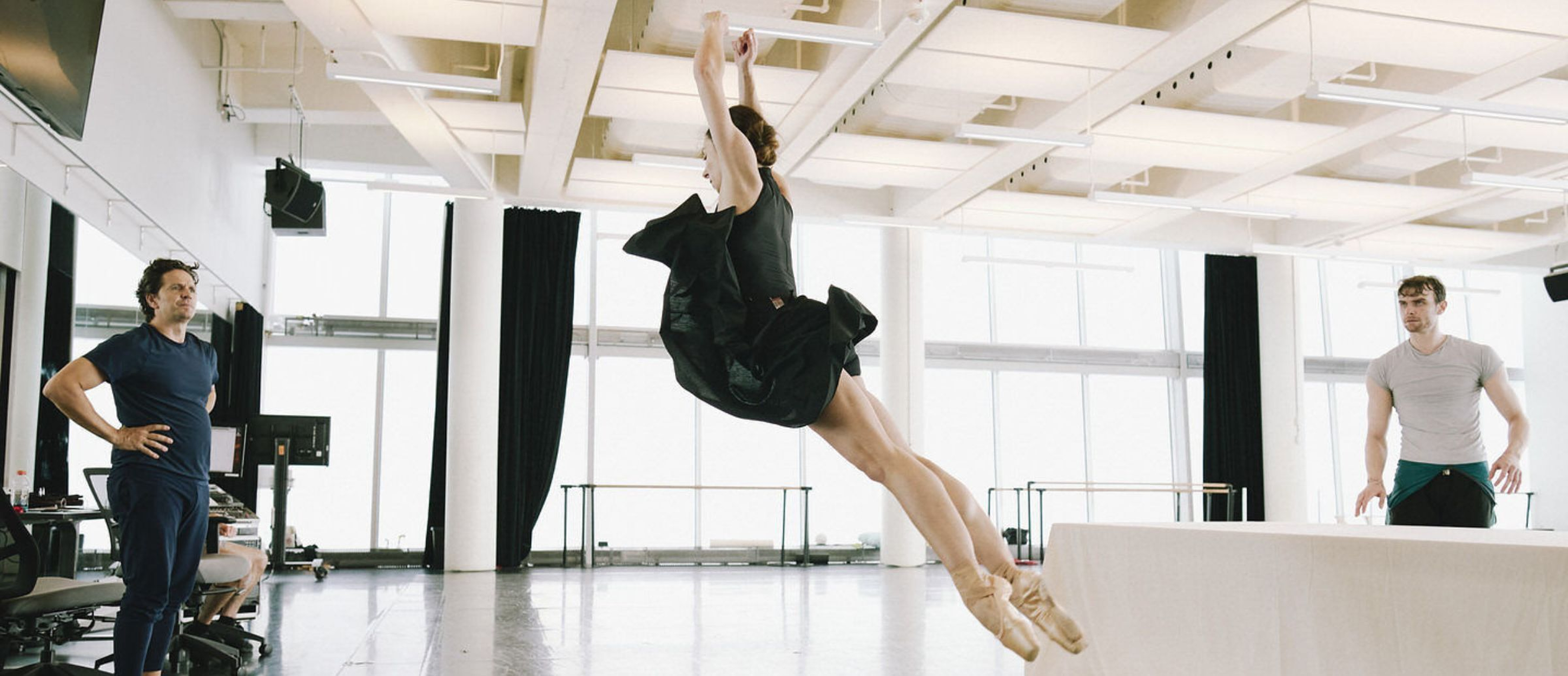
His Midsummer Night Dreams, in which young lovers lose themselves over the course of a weekend wedding celebration, makes this tension the very driving force of the performance. “We begin with very classical conventions, even in terms of dramaturgy, as if we were in an old ballet. Then, the more the nectar from the magic flower flows through the environment, the more the body changes. The dancers gain the freedom to move their spines. In the second act, we are in Titania and Oberon’s dream, and the forest becomes the dance.” The nectar, poured onto sleepers’ eyelids, makes anyone fall in love with the first person they see upon waking. The mischievous Puck—who Côté has renamed Maya—spreads it.
Along the way, the choreographer challenges a few conventions. To Shakespeare’s two “very heteronormative” couples, whose hearts race and change targets at the whim of the potion, he adds a third, opening the door to homosexuality, throuples, and non-binary identities. “Superimposed on the classical codes, this creates a bizarre, unhinged character. That is what interests me.”
Love Without Absolutes
Why a Dream, after the tragedy of Hamlet? Because Shakespeare wrote it around the same time as Romeo and Juliet, as the flip side of the same inquiry. “On one hand, the drama, the intensity. On the other, almost the absurdity of love, the way feelings can change overnight, the power dynamics.” And because the director of the Festival des arts de Saint-Sauveur sees a lot of “very, very dark” dance, he wanted something lighter.
A lightness that is anything but frivolous. Having gone through a divorce himself, Côté is wary of romantic absolutes. “What serves love best is not defining the relationship, keeping it organic, based on appreciating the other person and communicating. We value the stereotypical relationship—my boyfriend, my girlfriend—so much that we forget all the others: friendships more precious than a toxic relationship, the love between a mother and her daughter...” His show embraces a pluralistic definition of love, and does so, among other ways, with an approach that multiplies the dreamworlds on display and a staging that fully embraces the wondrous and the magical.
For Côté, ballet lends itself perfectly to this. “It’s hard to pretend you’re a normal person on stage when you’re wearing pointe shoes,” he says with amusement. “The magic, however, goes without saying.” To bring it to life, he surrounded himself with young Quebec designers to whom he was keen to give a chance, and who took the dream further than he could have done alone. Starting with Rémi Van Bochove, who populated the forest with creatures that are part human, part plant, with long, gnarled fingers.
Pollen in the Pit
On the music front, Les Grands Ballets Orchestra will mostly perform Mendelssohn—his symphonies, discovered in Yannick Nézet-Séguin’s recording with the Chamber Orchestra of Europe. “There’s a very complex joy in his music, full of nuances.” The Blue Danube accompanies the descent into the dream, Max Richter bridges the gap to the second act, and young Montrealer Tommy Lunaire weaves an electronic tapestry associated with the nectar using the calls of frogs and crickets. “Pollen is the electronic sound in the air,” Côté summarizes. At the dream’s peak, orchestra and electronic soundtrack intertwine, before the adagio of the Third Symphony restores calm.
A collage? Côté rejects the word. “It took time to create a soundtrack that doesn’t sound like a playlist.” In any case, it shouldn’t put little boys from Alma to sleep.
Upcoming Event
-
Contemporary Ballet
Midsummer Night Dreams
October 29 to November 1, 20265 performancesSalle Wilfrid-PelletierFrom William Shakespeare’s ancient Greek forest to Guillaume Côté’s contemporary creation, Midsummer Night Dreams has transcended the centuries without losing any of its mystery.
 New date added


Symphony of Life: An Orchestre Métropolitain Concert in Natural Symbiosis with the Film Murmurs
Marie-Julie Dallaire’s film murmurs will have a lavish premiere: a screening, with its original score performed live by the Orchestre Métropolitain under the direction of Yannick Nézet-Séguin. The film’s director spoke to us about how it came to be.
Article Interviews Event
Christos Papadopoulos: Dance as a Metaphor for Life
This autumn, we’re celebrating the euphoria of being alive with My Fierce Ignorant Step, a captivating new work by internationally renowned choreographer Christos Papadopoulos.
Article Portraits Artist
Les Quatre Saisons du Québec: Musical Pleasure According to François Dompierre
Article Interviews Event
Kim O’Bomsawin: Telling Stories to Bring People Together
Abenaki sociologist, filmmaker, documentarian, and screenwriter Kim O’Bomsawin will be the curator of the next edition of the Micro ouvert autochtone. Learn more about this profoundly human creator.
Article Interviews Event
Victoria May | Place des Artistes
Meet the inspiring Victoria May, a Métis choreographer and dancer who recently completed a residency at Place des Arts.
Vidéo Interviews Artist Residence Your favourites
 Email
 Facebook
 Shared events
