


 Home
Home
Can we still laugh when things have gone bad?

With the world in permanent crisis, do we still have a right to laugh? Last February, David Robichaud, a professor of philosophy at the University of Ottawa, was part of a panel on this very question, alongside comedians Léa Stréliski and Stéphane Fallu, and the General Director and founder of the École nationale de l’humour, Louise Richer.
Mr. Robichaud spoke to us about the origins of laughter and what it reveals about our humanity in the face of adversity.
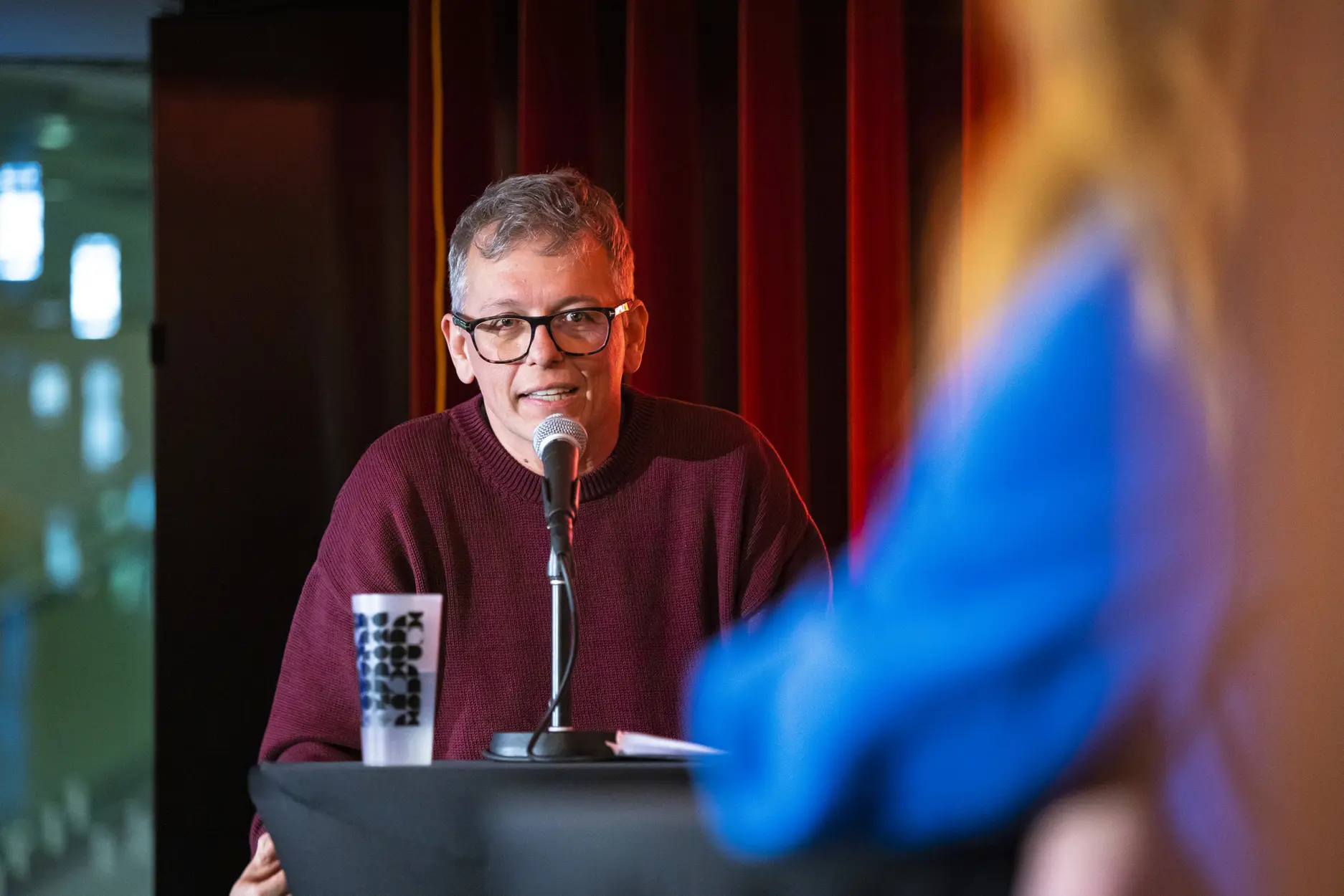
David Robichaud. Photo credit: Kevin Calixte.
Is it normal to want to laugh when everything is going wrong?
David Robichaud: The question is rather whether it’s immoral to find amusement and laughter in certain events when the world seems to be descending into chaos. As a specialist in political and moral philosophy, I like to put things into context. Cognitive science shows that we have the same brain we had 30,000 years ago, and that it evolved for a survival context in small groups. Originally, laughter was a reaction to a tense or dangerous situation: it was a signal to others indicating that the threat was contained and that everything was alright.
So laughter serves to defuse tension or conflict?
D.R.: Yes. There’s a signaling rationale at play: “I witnessed something, but since we’re laughing, it’s no big deal.” It’s a factor of cohesion. The anthropologist and biologist Robin Dunbar has shown that the cerebral response to group laughter is identical to that in monkeys grooming each other. It’s a fundamental social act.
Is humour always political?
D.R.: Humour may not always be, but laughter certainly is. When we laugh, we release hormones like endorphins and oxytocin, which predispose us to trust others. Politics is precisely that: managing collective projects and power within a group. Laughter acts as a social lubricant. Statistically, we also see that people in subordinate positions laugh more at their superiors’ remarks to demonstrate their willingness to collaborate. Laughter is more collective than individual: one study shows that we are even 30 times more likely to laugh at the same joke in a group than when we’re alone in our living room.
In the United States, late-night talk shows have become extremely politically charged (and caustic towards Donald Trump). What is your view on the way they have evolved?
D.R.: Laughter serves as a release valve in the face of absurdity. Political power rests on a symbolic dimension: people must believe in you. Late-night shows act as a countervailing power by saying, “The emperor has no clothes.” Authoritarian leaders fear humour because humiliation is more devastating than an attack on ideas. Telling a leader that he looks like a four-year-old in a schoolyard shatters his image as a strongman. Once people laugh, it’s too late for the leader, his prestige is tarnished.
Why is this type of caustic socio-political humour less prevalent in Quebec?
D.R.: I think we spare politics because it doesn’t seem to “deserve” such virulence! In Quebec, our parties are relatively centrist, and our politicians are quite respectable. We don’t have the equivalent of a Pete Hegseth [U.S. Secretary of Defense], an alcoholic who now has his finger on the atomic bomb! We mustn’t forget that comedians are also entrepreneurs who sell tickets: they’re reluctant to alienate part of their audience over a trifling subject. However, as soon as figures cross an accepted line, they become a regular target and a rallying point for comedy.
What impact has social media had on humour?
D.R.: Humour is a vehicle for social norms. It rubs our noses in our own shortcomings by highlighting our contradictions, such as the gap between our ideals and our actual behavior. The risk of social media is the echo chamber effect: if you laugh alone in your digital bubble, humour loses its potential to raise collective awareness. It’s laughing in a group, with 300 other people, that forces us to take stock. If everyone laughs at a joke about male chauvinists and you disagree, you suddenly realize that your ideas aren’t as widely shared as you thought…
Female comedians have really taken off in recent years, with stars for whom nothing is taboo—like Laura Laune in France or Rosalie Vaillancourt in Quebec. What do you think of them?
D.R.: The feeling of subordination among women is fading, thereby liberating laughter. Historically, studies have shown that men laugh less at women’s jokes, often as a reflex of dominance. In moving towards equality, this biological constraint is breaking down. The more women take to the stage, the greater their social power to highlight our contradictions becomes. When a female comedian adopts a raw, uninhibited tone about taboo subjects, she forces us to face reality in an engaged way. We no longer approach the subject in a purely intellectual manner; we integrate it through emotion and a sense of belonging to a group.
Laura Laune presents her show “Glory Alleluia” at Salle Wilfrid-Pelletier on April 4.
Spend an evening with American humourist David Sedaris, at Théâtre Maisonneuve on April 7.

Les Quatre Saisons du Québec: Musical Pleasure According to François Dompierre
Article Interviews Event
Kim O’Bomsawin: Telling Stories to Bring People Together
Abenaki sociologist, filmmaker, documentarian, and screenwriter Kim O’Bomsawin will be the curator of the next edition of the Micro ouvert autochtone. Learn more about this profoundly human creator.
Article Interviews Event
Jerry Seinfeld Live: The King of “Nothing” Returns to Montreal
Life’s little absurdities deserve our scrutiny, and no one knows how to give them that attention better than observational comedy’s biggest star, Jerry Seinfeld. We’re taking a look back at the comedian’s brilliant career.
Article Portraits Artist
Victoria May | Place des Artistes
Meet the inspiring Victoria May, a Métis choreographer and dancer who recently completed a residency at Place des Arts.
Vidéo Interviews Artist Residence
Gala de la Terre: A Concert in the Heart of Nature to Protect the Banks of the St. Lawrence River
To open the Festival de Lanaudière, the Orchestre de l’Agora, under the direction of Nicolas Ellis, is inviting the public to the 4th edition of its Gala de la Terre on July 4th.
Article Interviews Festival Your favourites
 Email
Email
 Facebook
 Shared events